
Tallahassee Previous Resident Sources
Choose the first record by period and by question. Deeds identify title parties, while city directories and census schedules are better evidence of a named household. Maps keep the land and address aligned. The local coverage is unusually deep because Tallahassee holds city, county, and state repositories in one place.
| Source | Years It Covers | Where Held | What It Shows |
|---|---|---|---|
| Clerk online Official Records | 1953 to present | Leon County Clerk portal | Grantor, grantee, instrument, book/page, legal description, image |
| Official books and microfilm | 1826 to 1952 | Clerk counters and branches | Earlier transfers, liens, and land descriptions |
| Leon deed Series L52 | 1825 to 1942 | State Archives | Archival bridge for early Leon land records |
| Verified Polk examples | 1927, 1930, 1936, 1940 | State Library / Florida Memory | Occupant, spouse, work, address, phone, and reverse listing |
| Federal census schedules | 1830 to 1950, as applicable | NARA and library databases | Household members, relationships, ages, work, and location |
| Historic maps | 1840 and 1883 verified | TLCGIS and State Library | Survey and owner-labeled geography across address change |
For a recent prior owner, start with the parcel sale citation and online deed. For a mid-century household, begin with a directory or census hit and confirm the parcel through title evidence. Earlier work often requires the Clerk's microfilm or a State Archives reference request. Permit coverage has no verified local start date, so use it only where a city or county custodian confirms a file.
Anchor Tallahassee Previous Residents
The Leon County Property Appraiser supplies the starting parcel. Copy its tax ID, location, owner, mailing address, parcel description, subdivision, tax district, acreage, and newest sales book/page. A parcel card may also show sale price, instrument type, improved or vacant status, building year, and structural facts.
Mailing and location fields are not interchangeable. Matching addresses can support an owner-occupancy hypothesis, but they do not prove it. A different mailing address may belong to an absentee owner, trust, business, or representative. Previous residents may have rented from any of them.
The legal or parcel description is a research aid, not deed text. Still, it is the best bridge to recorded title when street wording changes. Carry the parcel ID and subdivision or lot-block details into every later step.
Walk Leon County Deeds Backward
The Leon Official Records portal is indexed by party, instrument number, book and page, document type, recording dates, and legal or subdivision fields. A deed chain moves through those fields, not through a loose address match. Current owners usually appear as grantees on their purchase deed, while the prior owners appear as grantors.
- Copy the current owner, parcel ID, legal description, and newest sale book/page from the Property Appraiser.
- Open that purchase deed. Confirm the current owner as grantee, the predecessor as grantor, and the same legal description.
- Search the predecessor as a grantee in an earlier date range. Record the next grantor, instrument, recording date, book/page, and image status.
- Repeat the match by legal description. At 1953, take the last reliable citation to the Clerk's microfilm and counter indexes.
- For early Leon County land, ask the State Archives about Series L52 and cite the series, container, or roll details supplied.
- Grantor / grantee
- The grantor conveys a recorded interest; the grantee receives it.
- Chain of title
- The linked sequence of transfers affecting the same land.
- Legal description
- Lot-block, subdivision, or metes-and-bounds text that identifies land more reliably than an old street address.
View the grantor and grantee search before starting the chain.
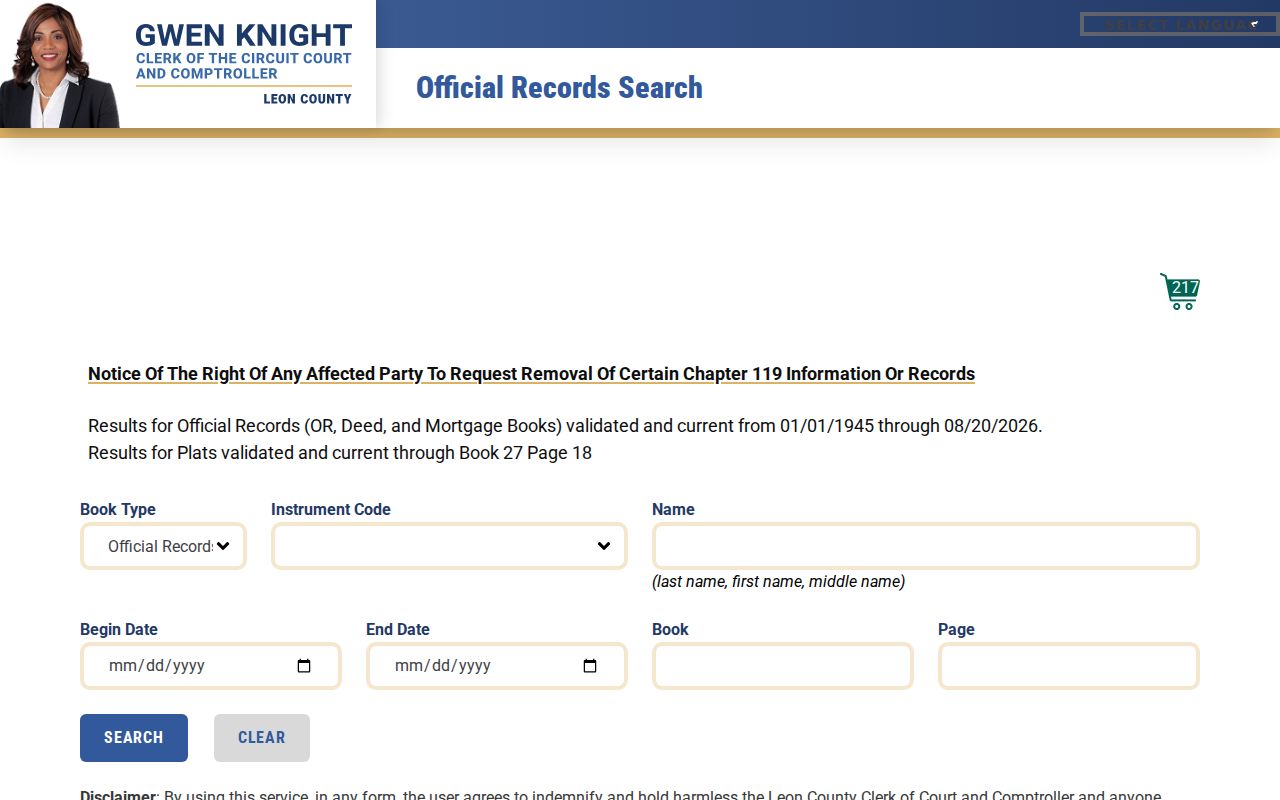
The portal image shows the party-based route used to move backward from seller to earlier purchase without relying on modern address text.
Tallahassee Records Cross 1953
Leon Official Records start in 1826, but online records and images begin in 1953. The years from 1826 through 1952 remain on microfilm. That split is an access change, not proof that the older deeds vanished or that scanning began in 1953.
The Clerk's Official Records Division provides search help at the courthouse and branches. A public image may require an image-view login or be Internet-restricted. Eligible records can be ordered through eCertify. Copies are $1 per page, plus $2 for each certified document. The Official Records direct line is 850-606-4030.
Check the Clerk's coverage and access page before planning an older search.
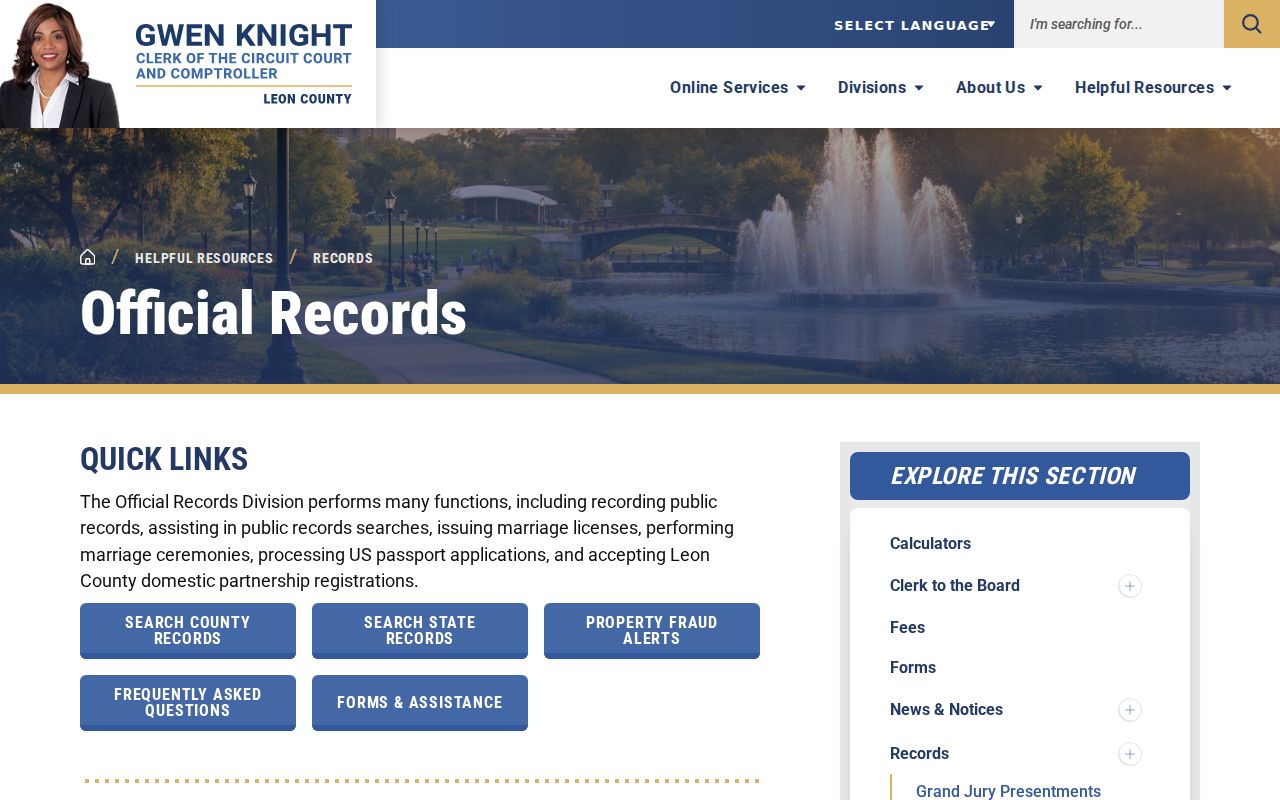
The captured official page marks the handoff from online searching to microfilm and custodian help.
Note: Ask for the exact book and page when possible; a narrow citation saves time and reduces copy work at the Clerk counter.
Keep Tallahassee Land Identity Stable
Tallahassee and Leon County adopted a joint Uniform Street Naming and Property Numbering System because inconsistent addresses caused delays for mail and emergency response. The research does not establish one citywide renumbering year. Never force an old number onto today's parcel without checking the historic directory street guide, plat, map, and legal description.
A parcel's subdivision, lot and block, or metes-and-bounds text can survive a street label change. Compare that language across each deed. Then use the 1840 GLO survey or owner-labeled 1883 cadastral map to relate early title to geography. Sanborn maps may show a footprint, use, and street context, but exact Tallahassee editions must be confirmed in the holding catalog.
This distinction prevents a common previous residents error: finding the right house number on the wrong road segment or assuming an omitted directory address was already built.
Pair Tallahassee Directories and Census
After the owner chain is stable, move to occupant evidence. Verified R.L. Polk Tallahassee volumes from 1927, 1930, 1936, and 1940 can show a name, spouse, occupation or employer, residence, phone, and householder or roomer mark. The reverse section begins with the street and number, making it a direct tool for past residents.
- Choose the directory year closest to a deed, move, death, permit, or family event. Copy the entry exactly, including initials and abbreviations.
- Check the reverse street section for the listed householder and nearby numbers. Record any vacancy or omission as an observation, not proof.
- Pair 1930, 1940, or 1950 directory evidence with the public federal census schedule. Compare names, ages, relationships, work, and location.
- Move one directory issue earlier and later. Follow changed surnames, spouse names, work, and phone entries before deciding that a household moved.
- Return to the deed, map, probate, or obituary trail to resolve conflicts. Cite each source and year separately.
The Florida Memory example follows Leonard and Winifred Wesson through all four verified Polk years, two addresses, and changing work entries. The middle initial for Winifred changes across editions. That small quirk is a warning against rejecting or merging a match on initials alone. At 503 E. McDaniel, the reverse guide omits the address in 1930 and lists the Wessons by 1936. It may have been vacant, omitted, or not yet built; the directory alone cannot decide.
For details about publishers, shelves, and how entries read, use the Tallahassee city directory. The prior-resident trail uses those volumes as dated evidence rather than rebuilding the collection history.
Bridge Early Tallahassee House Records
The State Archives county and city records extend a Tallahassee house history beyond the web. Besides Leon deeds in L52, the archives describes Tallahassee's legal-instrument register index for 1825 through 1897 as Series L27.
Estate records can explain a transfer when an owner disappears from the chain. Leon Series L72 contains inventories and appraisements in selected spans from 1853 through 1894. L73 covers personal-estate sales from 1860 through 1889. L78 contains petitions and orders concerning real-estate sale or division for 1845 through 1867 and 1885 through 1908.
Review the archival Leon County record examples before making a reference request.
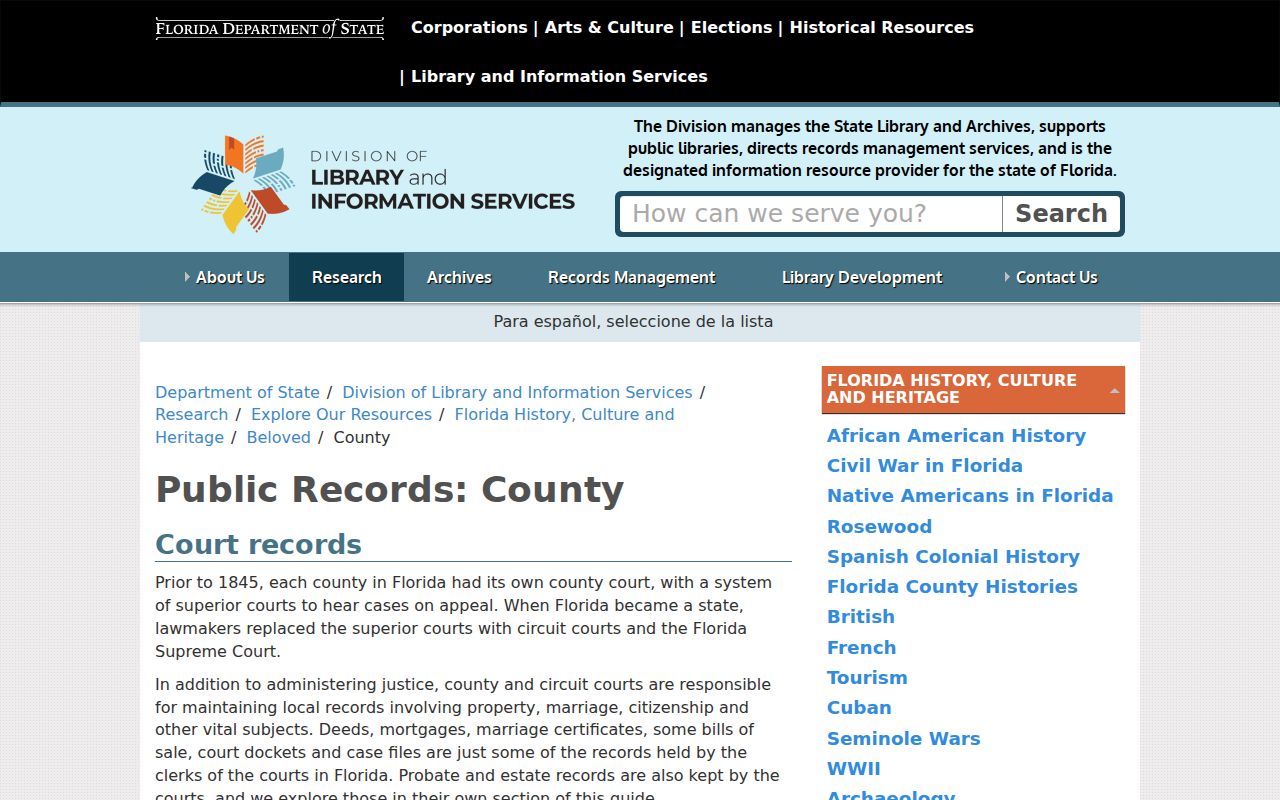
The archives page shows why catalog descriptions and series numbers matter: many unique records require a reference request or on-site use rather than a downloadable scan.
Close Tallahassee Resident Gaps
Probate and obituary evidence can join a former owner to heirs, a death, or a later conveyance. The Leon Clerk maintains public probate dockets and a separate microfilm name index that asks for the first letter of the decedent's last name. Use the returned case number to locate microfilm and request public petitions or orders. Party roles matter: a decedent, personal representative, heir, and attorney are not interchangeable.
Tallahassee's municipal cemetery search offers nearly 21,000 database rows and can return burial date, place of death, cemetery, block, section, lot, and grave. It does not cover most private burials, and the city is still reconciling the database with physical sites. An obituary or memorial entry is a lead; a cemetery register, probate filing, or death certification supplies a more formal check.
Use these endpoints to explain why a title changed or where a known person went. Do not use them to infer that every heir lived at the property.
Judge Tallahassee Previous Resident Evidence
Owners are only one layer of a Tallahassee address. Directories and census schedules can name renters and family members, but both have gaps. A printed annual volume may lag a move or omit a person. The census appears by decade and uses its own geographic framework. Obituaries can connect relatives and places, while probate states legal roles in an estate.
Mark each finding as title, tax, directory, census, map, permit, probate, obituary, or cemetery evidence. A previous residents conclusion is strongest when at least two independent sources agree on the person, date, and place. When they conflict, preserve both citations and test spelling, initials, spouse, occupation, legal description, and dates.
Lawful use. Tallahassee previous residents research is suited to house and family history. Never use a record trail to track, threaten, harass, or harm a living person.
Address Confidentiality Program participants and other protected people may be absent or redacted. Respect the gap. A public-record custodian can explain the law behind a withheld field, but cannot release information made confidential by statute.