
Tallahassee Directory Editions on Record
Four R.L. Polk editions provide a verified starting run for Tallahassee city directory research. Florida Memory's worked example uses the 1927, 1930, 1936, and 1940 books. The State Library of Florida city-directory collection spans the early 1900s to the present statewide, but Tallahassee years must be checked one at a time in its catalog. That distinction matters. A statewide date range does not prove that every annual Tallahassee volume survives.
| Collection | Years | Where Held | Access |
|---|---|---|---|
| R.L. Polk Tallahassee editions | 1927, 1930, 1936, 1940 verified | State Library; selected Florida Memory material | Catalog request, on site, or digitized example |
| Street and reverse sections | Verified in the Polk example | Within the directory volumes | Name-to-address or address-to-householder use |
| Telephone books and newspapers | Years require catalog confirmation | LeRoy Collins and State Library collections | Reference request or in-library database |
| Census schedules | Public through 1950 as of 2026 | NARA and subscribed genealogy databases | Name and place search |
No official source found a complete continuous run. Call the State Library Reference Desk at 850-245-6682 before travel, and give staff the city and target year. The LeRoy Collins Leon County Public Library can also check newspapers, local history, and licensed genealogy resources. These access channels are useful when a catalog record describes an item but no scan appears online.
Tallahassee Directory Research Desks
The State Library and State Archives share the R.A. Gray Building. The Archives research room is on the second floor at 500 S. Bronough Street and is open weekdays from 9 a.m. to 4:30 p.m. Archives reference staff can be reached at 850-245-6719. A good request names the series, collection, container, or folder when those details are known. Catalog descriptions do not always mean that the record itself is scanned.
The State Library and Archives resource hub connects city directories with census, tax, voter, manuscript, and map holdings. LeRoy Collins Leon County Public Library adds local newspapers and reference help. For archival referrals, the Tallahassee Historical Society explains that its collecting material is placed with the State Archives rather than kept in a separate society archive.
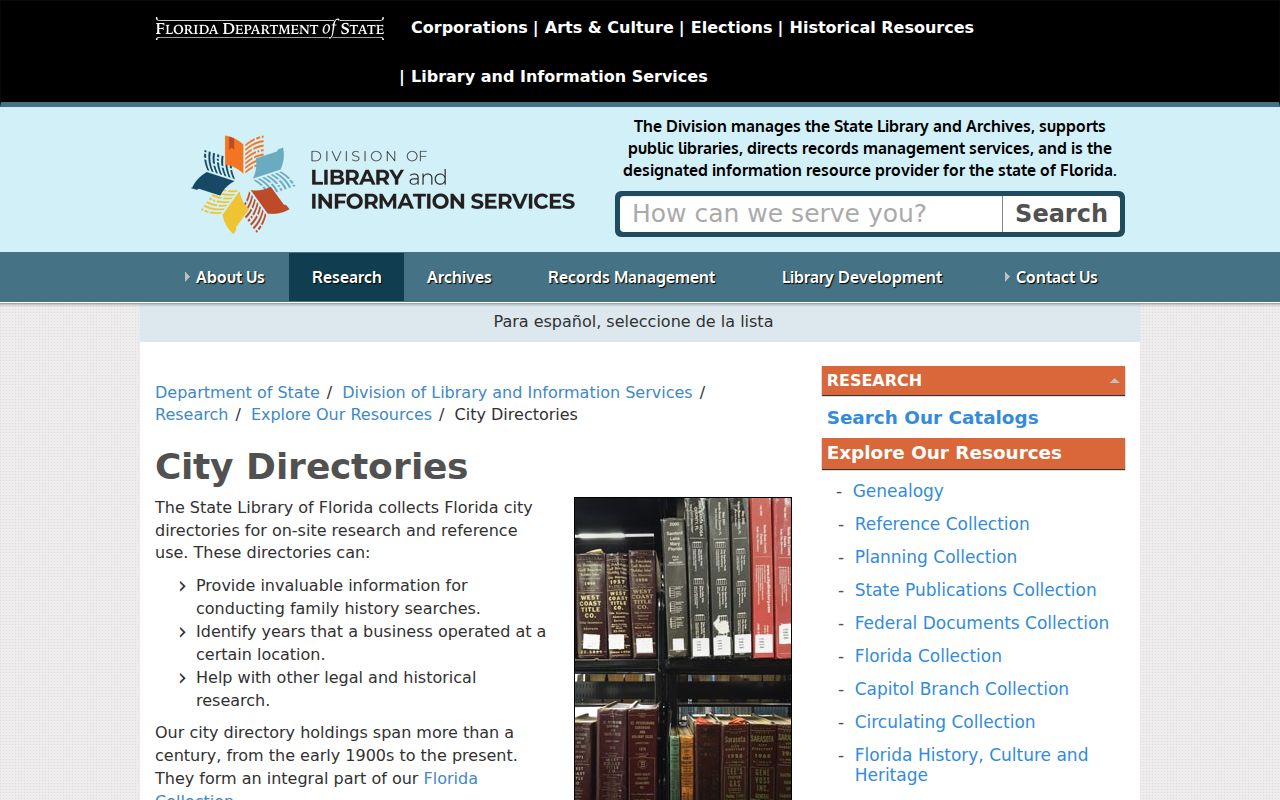
The State Library's collection page is the source for the image below. It shows the official route for checking Florida directory holdings before an on-site visit.
The Tallahassee Historical Society's official description is shown below. It clarifies the society's educational and referral role and points collection research toward the State Archives.
Before visiting, separate the request into a printed-volume question and an archival-record question. The State Library Reference Desk handles directory holdings. Archives staff handle series such as Leon deeds, city legal instruments, and estate files. That split saves time and gives each desk enough detail to check the correct catalog or container.
A Tallahassee Household Across Editions
Florida Memory follows Leonard and Winifred Wesson through the four verified Polk editions. Their entries connect the household to 503 E. McDaniel and 403 E. Park while recording changes in occupations and other details. The example is valuable because it shows the method, not just a result: copy the entry, compare the next volume, then use the street section to test the address.
One small change carries a large warning. Winifred's middle initial differs between editions. Initials, spelling, a spouse's name, and an occupation should be treated as a group of identity clues. No single initial should decide whether two Tallahassee city directories refer to the same person. The reverse guide also omits 503 E. McDaniel in 1930, while the Wessons appear there by 1936. That supports a date range, but it does not by itself prove when a building was finished or why the earlier entry is absent.
Tallahassee Directory Time Markers
The known dates form a careful timeline rather than a claim of continuous publication. Tallahassee became Florida's territorial capital in 1824, incorporated in 1825, and began municipal elections in 1826. County deeds, city legal instruments, census schedules, voter and tax rolls, and historic maps bridge the long period before the verified Polk snapshots.
- 1825-1897: State Archives Series L27 indexes Tallahassee legal instruments.
- 1826: Leon Clerk Official Records begin.
- 1927, 1930, 1936, 1940: Polk issues are verified by the Florida Memory example.
- 1950: The latest federal population schedule open under the 72-year rule as of 2026.
Decode a Tallahassee Directory Entry
A Polk listing is compact. Read it as a set of fields rather than a full account of a life. The alphabetical entry may show a surname and given name, a spouse in parentheses, an occupation or employer, residence, telephone detail, and a one-letter household or tenure code. The street section reverses the route by placing named householders beneath an address. The volume's own key controls each abbreviation, so save that page with the entry.
| Name and spouse | Printed spelling, initials, and a spouse shown in parentheses |
|---|---|
| Work | Occupation and, in some entries, employer |
| Residence | House number, street, and any telephone detail |
| Household code | The example explains “h” as householder or homeowner in context |
| Residence code | The example explains “r” as roomer, renter, or resident in context |
- Criss-cross directory
- A section arranged by street and house number rather than surname.
- Householder index
- An address-order list of the person named as the household contact, not a full occupant roll.
- Abbreviation key
- The volume's legend for short codes. Its meaning governs that edition and should be copied first.
Black Tallahassee in Directory Records
Published directories can preserve evidence that is hard to see elsewhere, while also reflecting the bias and omissions of their era. Tallahassee's Smokey Hollow history uses a 1904 directory to identify five houses on Riley's Jefferson Street block, all owned by Black men. By 1919, six homeowners on that block were Black. Public works later transformed the community in the 1950s, making these address-level listings especially useful for reconstructing the earlier neighborhood.
Broader family research can continue in the Riley Digital Archive, whose digitization work spans 850 linear feet and includes Obituaries & Obsequies from the 1800s through 2017, Black family papers, reunion programs, and First Lincoln High School material. FAMU's Meek-Eaton Black Archives reports more than 500,000 records and artifacts. FSU Special Collections also offers public reading rooms and university heritage records. These distinct collections help correct gaps in a printed Tallahassee city directory.
Local newspapers add another check. Tallahassee has general, Black-community, and university publications, including the Tallahassee Democrat, Capital Outlook, FAMUan, FSView, and Florida Flambeau. Search a narrow date around the directory year, then compare a street, school, church, or family name. Institutional ties are especially useful in a capital and university city, where residents may appear in state, legislative, FSU, or FAMU archives as well as local records.
Tallahassee Records Beyond Directories
Several record sets can test a directory find. State Archives Series L27 indexes Tallahassee legal instruments from 1825 through 1897. Leon deeds in Series L52 cover 1825 through 1942. Federal census schedules add household relationships, ages, and occupations at decade intervals, while the 1840 GLO survey and an owner-labeled 1883 cadastral map help connect old land descriptions to place.
The municipal cemetery database offers nearly 21,000 rows and accepts a prefix search or a contains search made with a leading percent sign. Results can show burial date, place of death, cemetery, block, section, lot, and grave. It does not cover most private burials, and reconciliation with physical sites continues. Use it as a city-held burial lead, then compare an obituary, probate file, and cemetery register.
| Period | Tallahassee record layer | Best use |
|---|---|---|
| 1825-1897 | City legal-instrument index L27 | Early named legal activity |
| 1825-1942 | Leon deeds L52 | Land and ownership links |
| 1927-1940 | Verified Polk editions | Annual household and address snapshots |
| Through 1950 | Public federal census schedules | Household and relationship checks |
Early estate records can add kinship and property detail. State Archives Series L72 contains inventories and appraisements in selected spans from 1853 through 1894. Series L73 covers personal-estate sales from 1860 through 1889, and L78 includes petitions and orders for real-estate sale or division in spans from 1845 through 1908. Ask reference staff for the series and target name rather than requesting every estate book.
Tallahassee became the territorial capital in 1824 and incorporated in December 1825. Municipal elections followed in January 1826, while Clerk Official Records begin in 1826. Those dates explain why city, county, and state repositories overlap so closely. They also make the local legal-instrument register a strong companion for people who appear before the first verified Polk volumes.
Trace Families in Tallahassee Directories
Begin near a known Tallahassee event, such as a marriage, birth, school year, or death. A city directory is an annual snapshot, not proof of title or a full household census. Keep the exact spelling and role from each entry, then test those details against the years on both sides.
- Find the surname in a verified edition near the known event and copy the whole line.
- Move to the prior and next available years, noting spouse, work, telephone, and address changes.
- Check the street-order section for the householder and nearby names at the address.
- Pair 1930, 1940, or 1950 directory evidence with the matching public census schedule.
- Use maps when the address changes, then close the trail with deeds, probate, obituaries, or cemetery records.
A disappearance has several possible causes: a move, death, marriage and name change, military absence, omission, or publication lag. Check more than one later edition. For a modern name or address question, use the official record methods described in the resident lookup rather than extending an old directory entry beyond its year.